PR Babysitter
Shepherd PRs through review, CI, rebase, and merge. Human stays in the judgment seat.
Read pattern → Starter →
Run one command in any repo. @cobusgreyling/loop is the front door (init + doctor). loop-init still works. Prints your Loop Ready score plus the first run line.
npx @cobusgreyling/loop init .
npx @cobusgreyling/loop doctor .
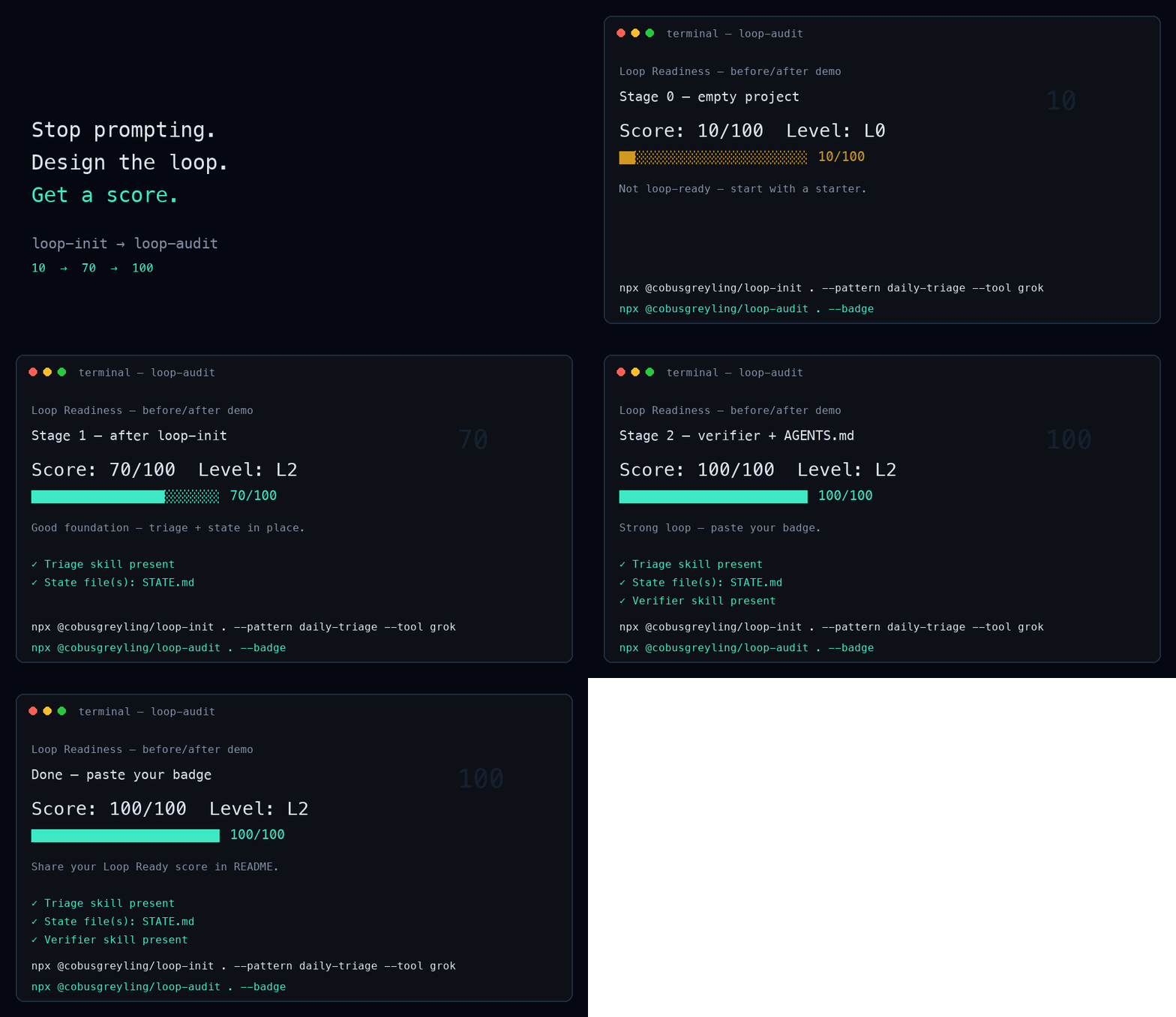
"You shouldn't be prompting coding agents anymore. You should be designing loops that prompt your agents."— Peter Steinberger
"I don't prompt Claude anymore. I have loops running that prompt Claude. My job is to write loops."— Boris Cherny, Head of Claude Code
"Build the loop. But build it like someone who intends to stay the engineer, not just the person who presses go."— Addy Osmani
Anatomy
You design it once. You're not prompting every micro-step.
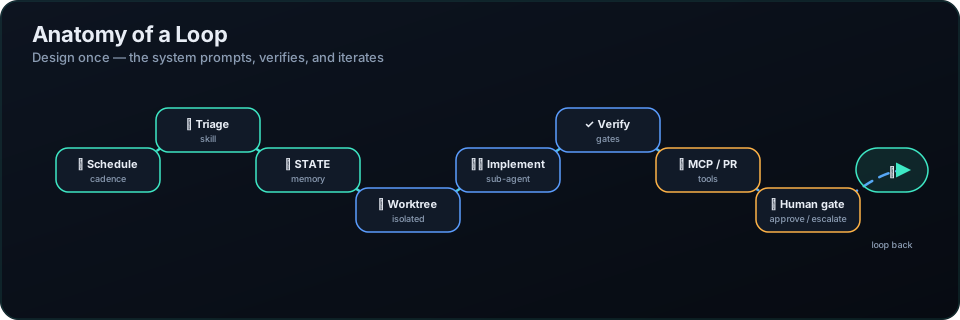
Building blocks
The same shape works in Grok, Claude Code, Codex, OpenClaw, Opencode, and Actions. Tool names differ; capabilities converge.
/loop, cron, automations
Parallel without collisions
Intent written once
MCP → real tools
Maker / checker split
Memory outside the model
Deeper architecture
The actor-level sequence within a run, the states it passes through, how the three autonomy levels relate, and how the tools in this repo map onto the primitives above.
sequenceDiagram
    actor Eng as Engineer
    participant Sched as Scheduler
    participant Skill as Triage Skill
    participant State as STATE.md / Memory
    participant WT as Worktree
    participant Maker as Implementer Agent
    participant Check as Verifier Agent
    participant MCP as MCP / Git / Tickets
    participant Gate as Human Gate

    Sched->>Skill: Fire pattern (e.g. daily-triage)
    Skill->>State: Read goals + last run + budget
    State-->>Skill: Context snapshot
    Skill->>WT: Create isolated worktree
    WT-->>Skill: worktree path
    Skill->>Maker: Task with skills + constraints
    Maker->>Maker: Implement change in worktree
    Maker->>Check: Hand off patch
    Check->>Check: Run tests + policy gates

    alt Verify pass and budget OK
        Check->>MCP: Open PR or update ticket
        MCP-->>Gate: PR link + summary
        Gate->>Gate: Safe and allowlisted?
        alt Safe auto-path
            Gate->>MCP: Approve merge or leave L1 report
            MCP->>State: Write run outcome
        else Risky or ambiguous
            Gate->>Eng: Escalate with full context
            Eng->>MCP: Decide / override
            MCP->>State: Write decision + outcome
        end
    else Verify fail or budget exceeded
        Check->>State: Log failure mode
        Check->>Eng: Report only, no auto-merge
    end
stateDiagram-v2
    [*] --> Scheduled
    Scheduled --> LoadingContext: cadence fire
    LoadingContext --> BlockedBudget: budget exceeded
    LoadingContext --> RunningTriage: context OK
    RunningTriage --> WorkingInWorktree: task selected
    RunningTriage --> IdleNoop: nothing to do
    WorkingInWorktree --> Verifying: implementer done
    Verifying --> AwaitingHumanGate: verify pass + risky
    Verifying --> Failed: verify fail
    AwaitingHumanGate --> Applied: human or allowlist approve
    AwaitingHumanGate --> Rejected: human reject
    Applied --> Logged
    Failed --> Logged
    Rejected --> Logged
    BlockedBudget --> Logged
    IdleNoop --> Logged
    Logged --> [*]
stateDiagram-v2
    [*] --> L1_ReportOnly
    L1_ReportOnly --> L2_Assisted: audit score up + human OK
    L2_Assisted --> L3_Unattended: denylist + budget + gates proven
    L3_Unattended --> L2_Assisted: incident or cost spike
    L2_Assisted --> L1_ReportOnly: kill switch
    L3_Unattended --> L1_ReportOnly: kill switch
flowchart TB
    subgraph Human["Engineer / Owner"]
        Design[Design LOOP.md patterns]
        Gate[Human gate + kill switch]
        Review[Read PRs + reports]
    end

    subgraph Control["Control plane"]
        Sched[Automations / Scheduling]
        Patterns[patterns/registry.yaml]
        Cost[loop-cost: estimate spend]
    end

    subgraph Memory["Durable memory"]
        State[STATE.md]
        LoopDoc[LOOP.md]
        Context[loop-context: prune, inject, circuit breaker]
        Sync[loop-sync]
    end

    subgraph Execution["Execution plane"]
        WT[loop-worktree: isolated attempts + locks]
        Maker[Implementer sub-agent]
        Verifier[Verifier sub-agent]
    end

    subgraph Tooling["CLIs + connectors"]
        Init[loop init: scaffold]
        Audit[loop-audit: readiness score]
        MCP[MCP server: read-only policy + tools]
    end

    Design --> Patterns
    Init --> State
    Init --> LoopDoc
    Sched --> Patterns
    Patterns --> Cost
    Cost --> Context
    Patterns --> WT
    State <--> Sync
    WT --> Maker
    Maker --> Verifier
    Verifier --> Context
    Context --> Gate
    Verifier --> MCP
    Gate --> Review
    Audit --> Design
Copy & run
Documented loops with scheduling, skills, state schemas, verification, and honest failure modes.
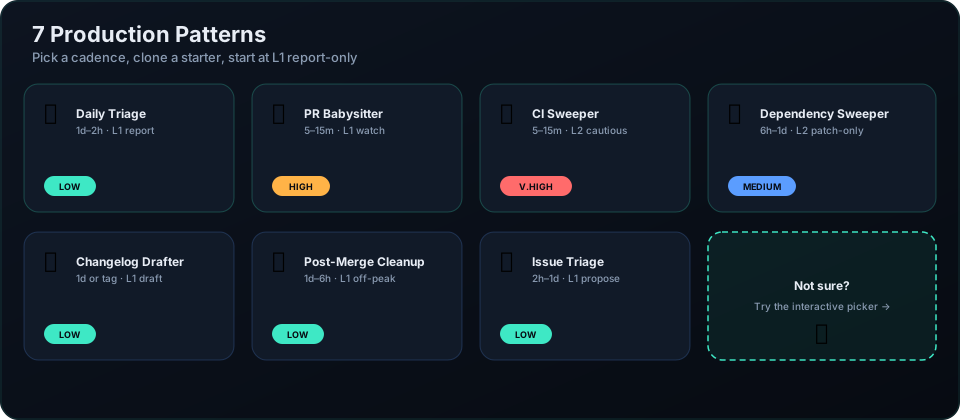
Shepherd PRs through review, CI, rebase, and merge. Human stays in the judgment seat.
Read pattern → Starter →Morning scan of CI, issues, and commits. Report-only week one, then small auto-wins.
Read pattern → Starter →React to failing checks with minimal fixes. Classify flakes. Escalate after 3 attempts.
Read pattern → Starter →TODOs, deprecations, and tech debt after merges. Small PRs overnight.
Read pattern → Starter →Patch CVEs and stale deps in worktrees. Majors and denylist stay human-gated.
Read pattern → Starter →Dedupe, score, and label incoming issues. Propose-only week one — pairs well with Daily Triage.
Read pattern → Starter →Scan merges & commits, produce polished categorized release notes drafts. Human approves before publish. Huge leverage, tiny risk.
Read pattern → Starter →5 minutes
Scaffold in your repo, audit readiness, run report-only for one week. Full quickstart guide →
# Scaffold starter (or copy manually)
npx @cobusgreyling/loop init . --pattern daily-triage --tool claude

# Score loop readiness (PRs get audit comments in CI)
npx @cobusgreyling/loop-audit . --suggest

# Grok — report only, week one
/loop 1d Run loop-triage. Update STATE.md. No auto-fix.

# Also try the new low-risk pattern
/loop 1d Run changelog-scan + draft-release-notes. Write RELEASE_NOTES_DRAFT.md. Human review only.
Quickstart guide · All starters · Design checklist · Production stories
Play with it
Pick your pain. See the exact loop + commands. Simulate your score live.
Check the boxes you already have (or plan to add). Score updates live.
loop-audit v1.4 scoring. L3 requires verifier + state + cost observability + proven activity.
Deep dives
Infinite fix loops, verifier theater, token burn — with mitigations.
Read catalog →Path denylist, auto-merge policy, MCP least privilege.
Read safety doc →Loop Readiness Score 0–100. Know before you ship unattended.
Run audit →CI red? PRs stalling? Morning chaos? Pick the right loop first.
Choose pattern →Stay in control
Loops should be boring and transparent. Use state files, run logs, and budgets.
The durable memory spine. Every loop reads it at start and writes outcomes.
See example →Structured JSON per run + daily token / spawn limits. Detect problems before they explode.
See sample logs →Automated Loop Readiness Score + suggestions. The reference dogfoods it.
Run it →The best loops are boring, reliable, and transparent.
Dogfooding
Machine-readable data rendered directly from loop-run-log.md. This repo runs loops.
Community
Forks mean people are trying this. Listed projects run (or adapted) loops from this reference.
Add yours via the Add Adopter issue
or a PR to docs/adopters.md.
Paste a badge in your README after loop-audit — social proof for your team and contributors.
npx @cobusgreyling/loop-audit . --badge
Reference implementation — loop-audit on every PR; readiness score 100.
Off-peak scan; verifier caught doc/API drift.
Propose labels only week one; pairs with morning STATE.md triage.
Hourly market/adoption research loop; durable state in control plane & evidence boundaries.
One line on what worked or broke — failures are first-class.
List yours →